05/10/2026
Dr Andreja Rafaelič, Head of the Centre for Deinstitutionalisation at the Social Protection Institute of the Republic of Slovenia (IRSSV), participated in the international conference Everything, Everywhere, All at Once? Aging, Human Capital, and Economic Transformation, held on 1 and 2 October at the World Bank premises in Paris. The conference was jointly organised by the World Bank Group, the London School of Economics (LSE) and the Centre for Economic Policy Research (CEPR). It focused on the impact of demographic change and population ageing on the economy, the labour market, social protection systems and well-being.
Dr Andreja Rafaelič was invited to the conference due to Slovenia’s experience with deinstitutionalisation reform and the establishment of the long-term care system. The Slovenian experience was recognised as an important example for discussing how countries implement complex systemic reforms in the field of social protection and respond to demographic change.
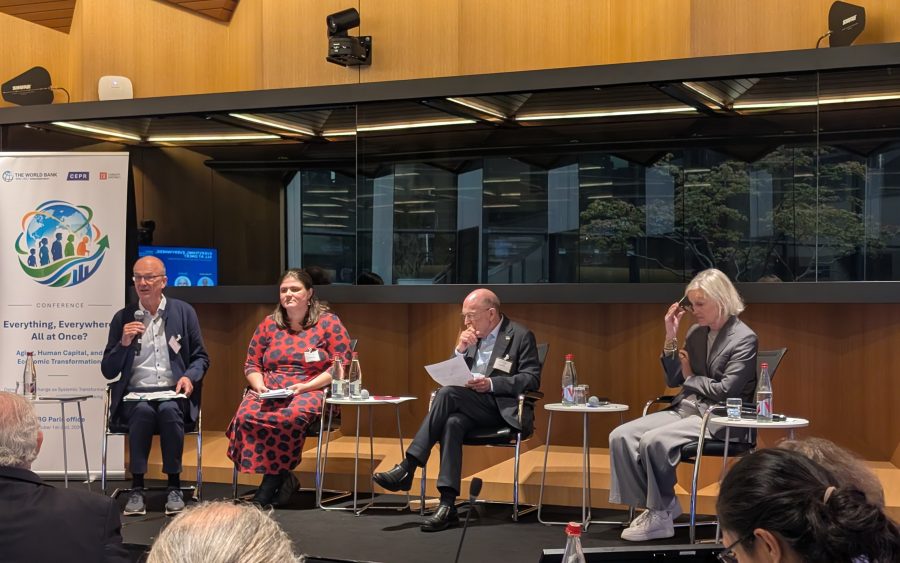
On the second day of the conference, she participated in the panel “A New Social Contract? Pensions and Long-Term Care in Transition”, alongside Prof. Nicholas Barr, Professor of Public Economics at the London School of Economics and Political Science; Dr Fiona Stewart, Lead Economist for Social Policy at the World Bank Group; Dr Adelina Comas-Herrera, Director of the Global Observatory of Long-Term Care at the London School of Economics and Political Science; and Monika Queisser, Senior Counsellor and Head of the Social Policy Division at the OECD.
Particular attention was paid to Slovenia’s long-term care reform. The organisers highlighted Slovenia as a country that is further ahead in long-term care reform than many other countries in the region. Dr Andreja Rafaelič presented the key features of Slovenia’s long-term care reform, its implementation to date, and Slovenia’s experience in introducing the reform. She also spoke about the involvement of different stakeholders in the reform process and the challenges arising from complex systemic changes.
Slovenia was highlighted several times in the discussions as an example of successful implementation of reforms in the areas of long-term care and the pension system. Representatives of the World Bank and the OECD recognised Slovenia’s experience as an important example in the European context, confirming that Slovenia can provide valuable experience to other countries in developing and implementing systemic responses to demographic change.
For the Centre for Deinstitutionalisation, participation in the conference was also important because deinstitutionalisation and the development of quality long-term care are closely interconnected. The transition from institutional forms of support towards community-based services and support is one of the key aspects of developing systems that enable people to exercise greater autonomy, choice and inclusion in the community.